




We use Rodenstock because we genuinely think they make some of the best spectacle lenses available. But a great lens is only useful if it has been chosen, measured and configured properly.
At Doctor Oculus, we use Rodenstock technology as the starting point, then tailor the lenses around your prescription, your frame and what you actually spend your life looking at. The aim isn’t to sell you the fanciest lens on the list. It’s to make your glasses feel as natural as possible.
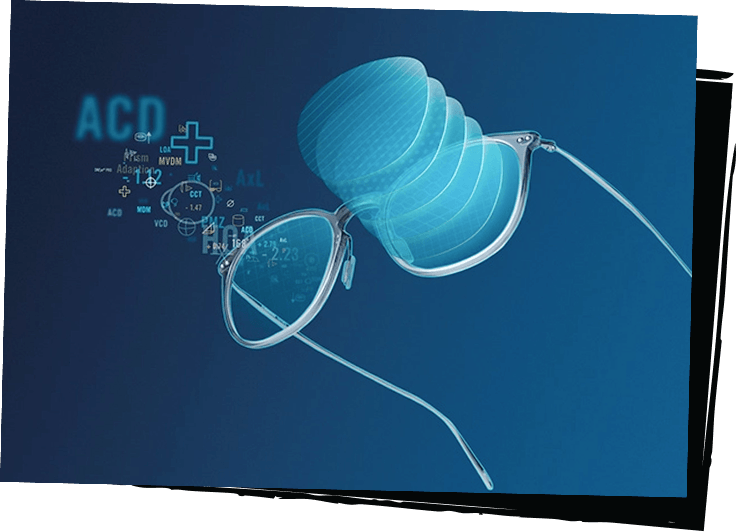

Rodenstock have been making lenses for more than 140 years, but what interests us is how far their modern lenses can be tailored around the individual wearing them.
Two people can have the same prescription and still need very different glasses. Their eyes sit differently in the frame, the frame itself sits differently on the face and they probably spend their days looking at completely different things. Rodenstock gives us the tools to account for much more of that rather than relying on a valid prescription.
That fits rather neatly with how we think glasses should be made.
The prescription is only the beginning. ImpressionIST lets us measure exactly where your eyes sit within the chosen frame and how that frame actually sits on your face.
That includes the position of each eye, the distance between your eyes and the lenses, the angle of the frame and how much it curves around your face. Those measurements can then be used when calculating compatible individualised Rodenstock lenses.
It sounds extremely nerdy because it is. It also means we don’t have to pretend everybody wears their glasses in exactly the same position.


A single prescription can still be made in very different ways. We consider the strength of your prescription, the frame you’ve chosen, lens thickness, how the glasses sit and what you’ll actually use them for, then choose and tailor the lens accordingly, prioritise reducing fatigue, or maybe prioritise sharp edge to edge vision. Simple job, properly done.

Good varifocals should become boring very quickly. Distance, screens and reading should fall naturally into place without spending the day searching for the clear bit. The lens design, frame and measurements all matter, so we tailor them together.

If you spend most of your day at a desk, an everyday varifocal can do the job, but it was never designed to spend eight hours staring at screens. Occupational lenses give us much more room for computers, reading and everything else within arm’s reach. You can loosen a screw with a butter knife. That doesn’t make it the right tool.

Proper sunglasses, with your actual prescription in them. Polarised, tinted, graduated and light-reactive options can all be built around what you need them to do rather than treating sunglasses as an optical afterthought.

Lens material, thickness, coatings, tint and edge finish rarely sound very exciting, but they can completely change the finished glasses. Each comes with their benefits as well as drawbacks so we recommend them when they genuinely improve the result, not because there happens to be another box available to tick.
Before choosing anything, we want to know what your current glasses do well, what annoys you about them and what you actually need the next pair to do. Then we choose the lens design, fit the frame and take the measurements needed to tailor everything properly.
Two people can have exactly the same prescription and leave with completely different lenses. That’s rather the point.

Every pair is dispensed and measured at Doctor Oculus, with the lens design chosen around your prescription, your frame and how you actually use your vision.
Most glasses also include a one-year warranty covering lens damage, a personalised laser-engraved glasses case and free plant-based lens cleaner with unlimited refills. Your first pair also unlocks special discounts on additional glasses, with savings of up to 50% off the total cost of frames and lenses.
We think these things should be part of buying good glasses, not a collection of extras added on at the end.
It depends on the lens type, the coatings, the prescription and the frame you’re putting them in. A simple single vision lens is not the same job as a varifocal, an occupational lens or a high prescription needing thinner materials.
We’ll talk you through the options and the cost before you commit to anything.
Mostly, but not always. Rodenstock is our main lens partner because the quality, consistency and customisation options suit the way we work.
If another lens genuinely makes more sense for your prescription, frame or use case, we can use that too. The point is not to be loyal to a logo. The point is to make the finished glasses good.
Typical turnaround is around 7 to 10 working days for many prescriptions, although complex prescriptions, varifocals, specialist coatings or unusual frames can take longer.
We’ll give you a clearer idea once we’ve chosen the lens.
A big chain optician or another practice may also sell Rodenstock lenses. The difference here is how they are chosen, measured and fitted.
We use ImpressionIST measurements taken with your actual chosen frame on your actual face, then choose the Rodenstock lens that genuinely suits your prescription, frame and how you use your eyes.
The lens is only ever as good as the fitting around it.